This project aims to design and build a replicable, sustainable irrigation system to help communities kickstart their agricultural economy. This system will allow villagers to grow crops such as cassava, okra, and squash during the dry season to help alleviate food insecurity while providing a source of income for farmers.
Santa Clara University, El Camino Real, Santa Clara, CA, USA
This project aims to design and build a replicable, sustainable irrigation system to help communities kickstart their agricultural economy. This system will allow villagers to grow crops such as cassava, okra, and squash during the dry season to help alleviate food insecurity while providing a source of income for farmers.
Santa Clara University, El Camino Real, Santa Clara, CA, USA
We designed a groundwater irrigation system using a solar-powered submersible pump, solar panels, irrigation lines, and sprinklers for a one-hectare plot of land. The goal for this system was for it to be affordable and replicable in order to allow other communities to implement their own version. To establish an accurate understanding of the crop water requirements, the team used a program called CROPWAT. This program is a tool developed by the UN’s Food and Agriculture Organization that calculates crop water requirements and irrigation requirements based on global soil, climate, and crop data. After using CROPWAT to analyze the planned crops, squash was determined to be the greatest water consumer (FAO, 2009). The flow rate was conservatively designed to meet that water requirement, which meant delivering 303 millimeters (mm) over the area every 10 days.
Since the system operated on solar power, the team designed for six hours of good sunlight to power the pump. The water requirement of 303 mm every ten days was converted into a flow rate of 14.1 liters per second (l/s) by multiplying the water requirement by the area of one hectare and completing unit conversions. This flow rate is extremely high, so the team decided to irrigate one-fifth of the field each day with a rotating system. The final flow rate was calculated to be 2.82 l/s. This works out to 60,600 liters per day.
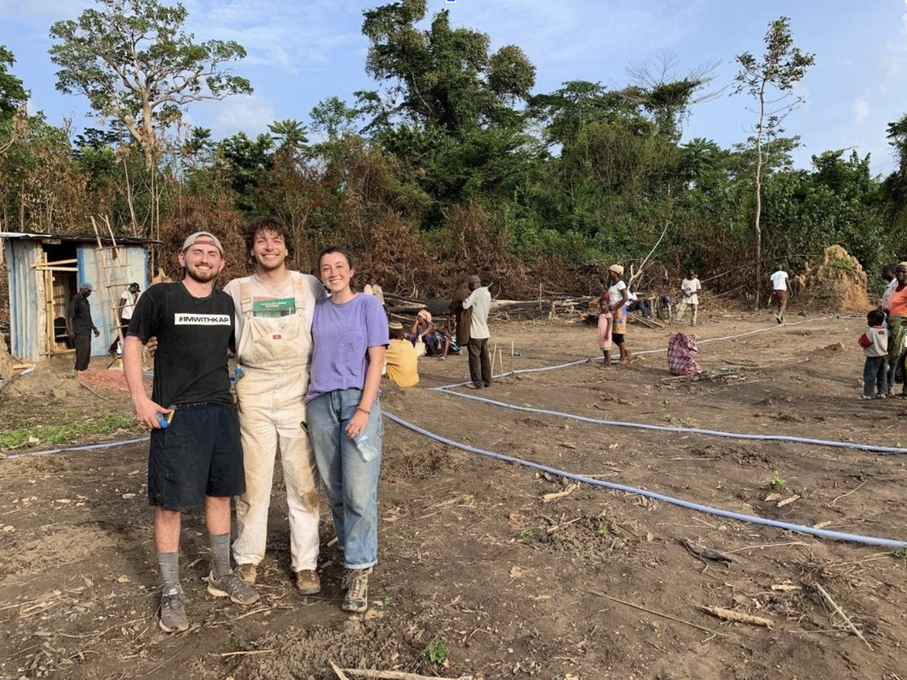
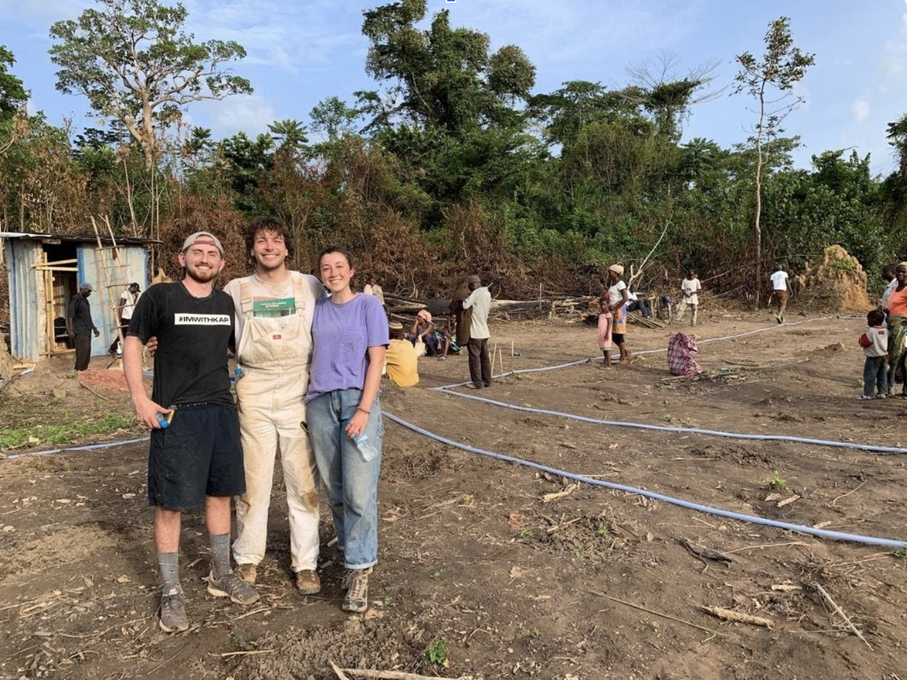
The final design was completed after alternative design discussions and final preparations in Santa Clara. The system began with the solar-powered submersible pump located 37 feet (ft.) down the 42 ft. deep well. The pump was connected to a discharge pipe, power cord, and safety cord. The pump connected to the blue discharge pipe, the yellow safety cord, and the black power cord. The power cord was connected directly to the pump control box placed inside a shed constructed seven ft. from the well. The pump control box was connected in series to four 24-volt (V) solar panels installed on top of the shed, as well as a lightning arrester and grounding rod buried three ft. deep located two ft. outside the shed, and a DC breaker connected to the wall next to the control box. The discharge pipe was connected to a PVC reducer directly above the well. The PVC adaptor was attached to a one-inch distribution hose that travels 10 ft. to the edge of the field. This hose connects to a second hose that runs along the top of the field.
The one-hectare field was to be divided into six 33.3 x 50 m plots, with the intention of each plot hosting a different crop. This spacing allowed for complete overlap of the sprinkler radius, which was 12.8 m so that no part of the field would be left unwatered. The sprinklers were installed at the top of each line, and then every 21.6 m. There are valves throughout the system, that control the flow of water so only one-fifth of the field is watered each day. As for the water requirements, the final design utilized four solar panels to power the pump. To calculate the necessary flow rate for the crops, the team conservatively assumed six hours of pump operation each day. The team converted the water requirement of 303 mm every 10 days into a flow rate of 14.1 l/s. Since this is an extremely high flow rate, the team decided to implement a rotating system of irrigation that would water one-fifth of the field each day. The re-calculated flow rate was 2.82 l/s.
The designed well was based on United States Geological Survey (USGS) and Schumacher Centre for Technology and Development recommendations and data, and information received from BRAID Africa regarding five wells in Janzon Town that had been constructed approximately 20 years earlier by the United Nations International Children's Emergency Fund (UNICEF). These five wells were all between 100-200 ft. deep, and the townspeople reported to BRAID Africa that two of the wells provided sufficient water consistently throughout the dry season. The Schumacher Centre for Technology and Development report Developing Groundwater recommended a six-inch diameter well for wells in rural areas (MacDonald, et al., 2005). Thus, the well design demanded a well that was 100-120 ft. deep, and six inches in diameter. From six inches above the ground to 20 ft. below ground there should be either steel or 14 PVC casing to protect the well from contaminated surface water. From 20 ft. below ground to 100-120 ft. below ground there would be screening with holes that were 0.1 - 0.4 square ft. in size to allow water to flow into the well (MacDonald, et al., 2005). There would also be a concrete apron and concrete cap to protect the well casing and borehole.
The aquifer characteristics were meant to tell the design team whether or not the constructed well could provide the necessary water each day. The Theis Drawdown Method was used to determine how far the water dropped each day. This method revealed the drawdown would be 15.8 ft. after six hours of pumping at 2.82 l/s each day (the design rate). It also showed that the next 18 hours would be enough to recharge the well to its original level each day. These values were approximate from the soil characteristics that were estimated from USGS averages (Heath, 2004) since no precise soil analysis could be performed by the contractors in Liberia. Affordability prevented the design team from recommending a deeper well. According to calculations, this well could provide the necessary water, depending on the exact soil characteristics surrounding the well. Local resources and time constraints, however, prevented this design from being implemented.
BRAID Africa had an affordable well contractor, trained by Oxfam International, that would construct the well using a hand-powered drill. This type of drilling prevented the contractor from breaking through a rock layer 42 ft. below the ground surface. The drill this contractor used was four inches in diameter, resulting in a much smaller well than designed. The constructed well was completed on February 20, 2019. The contractor provided a well log, detailing the soil types down the well, the depth of the well (46 ft.), and the depth to water (22 ft.). When the design team arrived in Janzon Town, one of the first steps was to check the well and determine the accuracy of the well log. Using a metal bracket attached to a string, it was determined the well was actually only 42 ft. deep and the water was 24 ft. down. The constructed well’s small diameter limited the amount of immediately available water in the well.
In order to purchase the correct pump for this system, the design team had to determine the total dynamic head. Total dynamic head is the addition of a static lift and friction losses. Based on the 16-well log received from the well contractor, the static lift was 24 ft. The total calculated friction loss was 14 ft. The total dynamic head, therefore, was 37.8 ft. The pump needed to be able to operate with this total dynamic head and provide at least 35 psi of pressure for the sprinklers to function properly. After internal discussions and a meeting with a design group from the University of Michigan who also completed a water project in Liberia, the design team began searching for pump options with SunPumps, a pump supplier from Phoenix, Arizona.
Based on the hydraulic requirements calculated, the team decided on the SCS 45-70-120 model (SunPumps, 2019). This pump had a power range of 75-120 volts. The pump was sized to fit in a well with a minimum diameter of four inches. In this system, the pump had to provide a flow rate of 2.82 l/s in order to provide the crops with the water needed to grow. The water demand was determined using CROPWAT. The pump system curve shows the pump is capable of operating at the calculated flow rate and total dynamic head. The curve also shows that if the system was placed in a deeper well, the pump could still operate within its range. The pump system purchased from SunPumps came with a 1.5 horsepower pump, the system control box, a 50 ft. power cord, a 50 ft. safety cord, and the 50 ft. drop hose. In order to attempt to provide the necessary water, the pump was placed 37 ft. down in the well.
A shed was constructed for several reasons. The solar panels that powered the pump had to be mounted in some way. Also, the pump controls and wiring had to be sheltered from rain and general exposure. Finally, the system needed security. The solar panels were connected to the 17 roof, then latched down with steel bars. The shed had a lock that kept the controls and wiring out of sight and reach. The shed was built out of tree trunks that had been cut down while clearing the field, wood planks from the town, and scrap metal for the walls. The shed was designed and built by BRAID Africa contractors. It had a six ft. by six ft. concrete floor and foundation, was built seven ft. from the well, and was approximately 10 ft. tall. The exact location of the shed was decided by the contractors with the hopes that it would be close enough to the well to provide security for materials without interfering with work near the well. The pump power cord was covered with a PVC pipe cut in half longways for protection between the well and the shed.
The SCS 45-70-120 model pump purchased from SunPumps was designed to run on 75-120 volts. Four 24-volt solar panels were purchased in Monrovia to provide this power. These panels were five ft. x three ft. This panel size and voltage was the best option available in Monrovia. The panels were connected in series to the pump system control box. The panels were connected in series in order to additively provide the system with a nominal voltage of 96 volts. In the relatively likely event of a lightning strike on the panels or the metal roof of the shed, a lightning arrestor was purchased to ensure the system was not destroyed due to a lightning strike. Additionally, a lightning rod and DC breaker were purchased to ground the entire system and protect the pump from power surges.
The sprinklers were purchased at a Home Depot in Santa Clara. The sprinklers' design specifications stated that they sprayed 360 degrees and had a radius of 12 m at 40 psi of water pressure. The radius of the sprinklers drove the iterative hydraulic design process; the radius determined the spacing of the lines, which determined how many sprinklers were needed, which determined the pressure losses. Twenty-five sprinklers were placed throughout the field. They were placed in series 21.6 m apart along each of the five irrigation lines traveling down the length of the field. The spacing of the five lines and the sprinklers were based on the 12 m radius of the sprinklers. The goal was to come as close as possible to ensuring that no space on the field was out of reach of the sprinklers.
The largest obstacle was operating as a satellite design team and relying on others for gathering the necessary information. This type of communication made it very difficult to get accurate descriptions of the field and surrounding area, the soil characteristics, aquifer characteristics, and materials and resources available in Liberia. Traveling to Liberia to survey the project site would have been impractical with the project’s funding constraints, so the project had to be designed through descriptions during video meetings, text updates through WhatsApp, email, photos, and ArcGIS for geologic data.
Some of the next steps needed to make this project truly replicable and sustainable would be a deeper search for alternate materials and models to reduce the overall cost of the project. Re-sourcing all the materials to Liberia reduces the return rate from six years to four years. Since the team left Liberia, a new well has been dug that is deeper and wider and the community has been able to operate the system successfully. Okra was recently harvested from the site.
The project was successful in establishing a groundwater irrigation system that could sustain crop life and be operated and maintained by members of the community. The project in its current design, however, is not replicable. The team anticipated purchasing more materials in Liberia than in the US and assumed materials would be less expensive in Liberia. While this is true, the team was not able to access these materials during the design phase and did not design for the 34 readily available materials in Liberia. The cost of the implemented project is prohibitive, however, the team hopes that through further investigations this project can be replicated sustainably.
The aim of this project was to develop a prototype that may be a model to help relieve food insecurity in rural Liberia. This was accomplished by designing a groundwater extraction, recharge, and irrigation system to facilitate year-long crop growth. The irrigation system that was designed for this project has allowed villagers to grow certain crops, such as cassava, okra, chard, and squash, during the dry season which will help alleviate food insecurity with the goal of providing a source of income for the farmers. This project was designed for a one-hectare (2.47 acres) plot, which can be scaled up or down depending on land area and available resources..
Description :The aim of this project was to develop a prototype that may be a model to help relieve food insecurity in rural Liberia. This was accomplished by designing a groundwater extraction, recharge, and irrigation system to facilitate year-long crop growth. The irrigation system that was designed for this... moreThe aim of this project was to develop a prototype that may be a model to help relieve food insecurity in rural Liberia. This was accomplished by designing a groundwater extraction, recharge, and irrigation system to facilitate year-long crop growth. The irrigation system that was designed for this project has allowed villagers to grow certain crops, such as cassava, okra, chard, and squash, during the dry season which will help alleviate food insecurity with the goal of providing a source of income for the farmers. This project was designed for a one-hectare (2.47 acres) plot, which can be scaled up or down depending on land area and available resources.. less



















 Loading ...